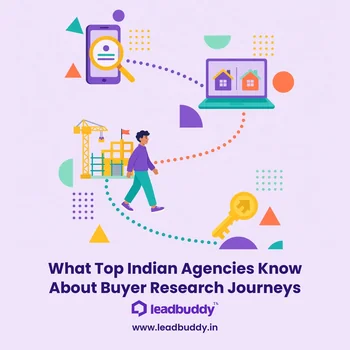
Understanding the Real Estate Buyer Research Journey in India
Nobody books a flat after one ad. Say you're a couple in Bengaluru, both working, looking for a 2 BHK near Sarjapur Road. Over the next two months you'll probably see a dozen reels, run thirty searches, compare listings on portals late at night, send screenshots to your parents, argue about commute times, visit three sites on two weekends and then, maybe, book.
That's a buyer research journey. The top real estate marketing companies in India plan for the whole thing, not just the last click. Here's what that looks like in practice.
Why isn't the buyer journey a straight line?
Marketing slides love neat funnels: awareness, consideration, decision. Real buyers loop around. They'll see your project, forget it, search a competitor, come back through a portal, ask a cousin and then search your project's name. A campaign built for a straight line will miss most of that.
We'd think of it in loose stages instead.
1. Drifting
The buyer isn't actively searching yet. Maybe the lease is ending in eight months, or there's a wedding coming up. They're scrolling, half-noticing property ads. Social video and short reels matter here, not lead forms.
2. Exploring
They start searching broad terms: "flats in Pune under 80 lakh", "new launch Thane". They open portals. They watch YouTube walkthroughs. They're building a mental map of areas and price bands.
3. Comparing
Now they've got a shortlist of four or five projects. They compare carpet area, price per square foot, possession dates, developer track record and RERA details. This is where landing pages, brochures and honest FAQs do their work.
4. Consulting
Picture the WhatsApp family group lighting up with screenshots. Parents, siblings, sometimes a friend who's "in real estate". The buyer needs shareable material: a clean PDF, a short video, a location map.
5. Visiting
The site visit is the turning point. The buyer wants to see the sample flat, feel the location and meet the sales team.
6. Deciding
Price negotiation, loan approval, payment plan, booking amount. The marketing job here is mostly to stay out of the way and keep the sales team supplied with answers.
What changes when you plan for the whole journey?
Planning for the whole journey means different content for each stage, search campaigns matched to intent, retargeting with a clear purpose, landing pages that answer comparison questions, and sales follow-up that fits where the buyer is. Instead of chasing one click, the agency guides a buyer from first curiosity to the site visit.
Different content for different stages
You don't need fifty creatives. You need the right few for each stage: a video for drifting buyers, clear comparison content for exploring and comparing buyers, shareable material for the family, and visit invitations for people who're ready.
Search matched to intent
Broad searches and project-name searches are very different. A real estate PPC management company will separate them into different campaigns with different bids, and use negative keywords to keep out renters, job seekers and resale hunters. Someone searching your project's name with "price" or "floor plan" is close to the end. Someone searching "flats in Pune" is just starting.
Retargeting with a purpose
Retargeting shouldn't just repeat the same ad. If someone watched a walkthrough, show them floor plans next. If they visited the pricing section, invite them for a site visit. A social media marketing agency for builders and developers should be able to sketch this sequence for you.
Landing pages that answer comparison questions
Comparing buyers want facts in one place. Put carpet area, configuration, price range, possession date, approvals and location on the page clearly. If the page makes them hunt, they'll go back to the portal. Testing these pages is the core job of a conversion rate optimization agency for real estate landing pages.
Sales follow-up that fits the stage
Not every lead's ready for a hard sales call. Say a buyer downloaded a brochure at the exploring stage. A pushy call might scare them off; a helpful WhatsApp with a video might not. Agencies and sales teams should agree on how to treat leads at different stages.
How do you measure a long journey?
Measure leads by source and stage, link site visits to first and last touch where possible, track time from enquiry to visit and visit to booking, and connect bookings in the CRM. It won't be perfect, because phones and offline conversations break tracking, but it beats judging every channel on last-click cost per lead.
The hardest part is measurement. If you only credit the last click, you'll undervalue the reel that first introduced the project and overvalue the branded search at the end. A performance marketing agency for real estate developers should track:
- Leads by source and by stage
- Site visits linked back to first and last touch, where possible
- Time from first enquiry to visit, and visit to booking
- Bookings linked back in the CRM
It won't be perfect. Phones, shared devices and offline conversations break tracking all the time. But it's much better than judging every channel on last-click cost per lead.
[Add LeadBuddy campaign data: typical enquiry-to-visit time seen in your projects]
The Indian twist
A few things make Indian buyer journeys distinct:
- Family consultation is common and can add weeks
- Festival timing, like Navratri, Dussehra, Diwali or Gudi Padwa, often decides when a booking happens
- Home loan approval can shape the final decision
- Brokers can enter at any stage, and buyers often talk to them in parallel
- Language may change between stages; a buyer might search in English but discuss in Marathi or Telugu at home
Questions to ask an agency
- How do you map the buyer journey for a project like ours?
- What content would you create for each stage?
- How do you separate broad and branded search?
- How do you measure channels beyond the last click?
| Journey stage | What the buyer is doing | What marketing should provide |
|---|---|---|
| Drifting | Casually noticing projects | Awareness video, social reels |
| Exploring | Searching areas and budgets | Search ads, area guides |
| Comparing | Weighing projects side by side | Comparison pages, floor plans, pricing clarity |
| Consulting | Discussing with family | Shareable brochures, WhatsApp-friendly content |
| Visiting | Booking a site visit | Easy booking, reminders, directions |
| Deciding | Final doubts | Fast answers, payment plan clarity |
Final word
Buyers take a winding road to a booking. The top real estate marketing companies in India don't try to force a shortcut. They show up with the right digital content at each turn and keep the sales team ready for the moment it counts.
At LeadBuddy, we plan campaigns around the full buyer journey and report site visits, not just clicks. Book a free strategy call and we'll map the journey for your project.
At LeadBuddy we're based in Mumbai, and whether a project sits in Thane, Navi Mumbai or another state, we'd start with the same checks.
Key takeaways
- Marketing slides love neat funnels: awareness, consideration, decision.
- Planning for the whole journey means different content for each stage, search campaigns matched to intent, retargeting with a clear purpose, landing pages that answer comparison questions, and sales follow-up that fits where the buyer is.
- Measure leads by source and stage, link site visits to first and last touch where possible, track time from enquiry to visit and visit to booking, and connect bookings in the CRM.
- A few things make Indian buyer journeys distinct:
- Buyers take a winding road to a booking.
Frequently asked questions
How long does a property buyer's research take?
It varies widely by buyer and project, from weeks to many months. That's why agencies need content and follow-up for every stage, not just the final click.
What is the Indian twist in the buyer journey?
Family consultation. Parents, spouses and relatives often join decisions and visits, so content must convince a group, not one person.
Why is last-click attribution misleading for real estate?
It credits the final branded search and ignores the reel or video that first introduced the project, leading to wrong budget cuts.