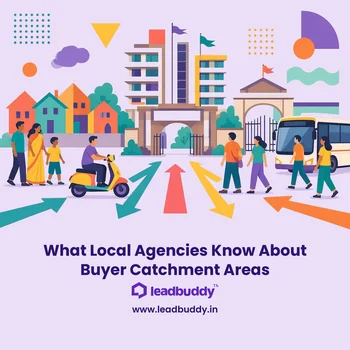
What Local Agencies Know About Buyer Catchments
Ask a seasoned site sales manager where buyers come from, and they'll often give you a surprisingly precise answer. "Mostly from these three areas, a few from that office park, and some families moving back from Pune." That's the catchment.
Good local agencies know catchments well, and it's one of the most useful things they can bring to your digital marketing. Here's what catchment knowledge looks like and how it should shape your campaigns.
What a catchment really is
A catchment isn't a circle on a map. It's the set of places your likely buyers live, work or are moving from. It can include:
- Nearby residential areas where people want to upgrade
- Office hubs within a reasonable commute
- Older parts of the same suburb with ageing buildings
- Specific communities with ties to the area
- Other cities, for people relocating or investing
Two projects a kilometre apart can have quite different catchments, depending on price, configuration and access.
How local agencies learn catchments
They usually learn from a mix of sources:
- Past projects in the same area and where those leads came from
- Conversations with site sales teams and channel partners
- Walk-in data and CRM records
- Their own familiarity with how people move around the area
That accumulated knowledge is hard to replicate quickly from a desk.
How should catchments shape digital targeting?
Meta and Google geo-targeting. Instead of a single broad radius, target several specific pockets. Layer in office hubs. Exclude areas that bring junk leads. Search keywords. Add locality names from the catchment, plus searches like "flats near [office hub]." A real estate ppc management company would build separate ad groups for these.
Creative. Mention commute times from catchment areas. "20 minutes to BKC" means something specific to someone who works there.
Landing pages. Add a section that shows travel times from the main catchment areas.
Why do buyer catchments change over time?
New metro lines, roads and office parks can shift catchments within a year or two. An agency that worked in the area five years ago might be using old maps in their head. Ask what's changed recently and how they've adjusted.
A hypothetical example
Say you're launching a 2 and 3 BHK project in Chembur. A remote agency proposes targeting a 15 km radius. A local agency suggests targeting Chembur's older housing societies, Ghatkopar, Kurla, parts of Sion, and office workers around BKC and the eastern suburbs' business parks, while excluding areas that mostly bring rental enquiries.
In this made-up case, the second approach is more likely to reach people who'd actually buy. You'd still test it, and the CRM data would tell you within a few weeks whether the catchment guess was right.
How to check an agency's catchment knowledge
- Ask them to sketch your catchment on a map in the first meeting.
- Ask which areas they'd exclude and why.
- Ask how they'd confirm the catchment with data after launch.
- Compare their view with your sales team's.
If they can't do the first one, they probably don't know your area yet.
How should catchment knowledge be combined with data?
The best approach combines both. Start with local knowledge to set initial targeting. Then use lead and site visit data to refine it. Pin codes in the CRM, distance of walk-ins, which ad sets bring visits. Over a couple of months, you'll have a catchment map built on evidence, not assumptions.
A performance marketing agency for real estate developers should be doing exactly this: starting with a hypothesis and correcting it with data.
How should catchment knowledge shape the budget?
Tighter targeting doesn't always mean lower cost, but it often means less waste. When you're weighing the cost of hiring a real estate digital marketing company, ask how they plan to use catchment targeting to protect your budget from irrelevant clicks.
Why shouldn't you forget NRI and out-of-city buyers?
Some projects have catchments well outside the city. Families in the Gulf, professionals in Bengaluru planning to return, investors in other states. These buyers need different targeting and messaging. A local agency may not think about them by default, so raise it if it fits your project.
Even the best real estate digital marketing agency in Mumbai will get catchments wrong sometimes. What matters is how quickly they notice and fix it.
Wrapping up
Catchment knowledge is one of the quiet strengths of a good local agency. It makes targeting sharper and copy more relevant. Pair it with data, and it gets even better.
If you're looking at real estate advertising agencies near me partly for this local insight, test it in the first meeting. And if you want help mapping your project's catchment, book a free strategy call with the LeadBuddy team.
Key takeaways
- A catchment isn't a circle on a map.
- They usually learn from a mix of sources:
- Meta and Google geo-targeting. Instead of a single broad radius, target several specific pockets.
- New metro lines, roads and office parks can shift catchments within a year or two.
- If they can't do the first one, they probably don't know your area yet.
Frequently asked questions
What is a buyer catchment area in real estate?
It is the set of places your likely buyers currently live or work, plus the routes they use, not simply a radius around the project. A sales manager can often name those areas with surprising accuracy. A good local agency turns that knowledge into targeting, keywords and landing-page directions, and then checks it against real lead and visit data.
How do local agencies usually learn a project's catchment?
They ask sales where recent visits and bookings came from, look at competing projects, walk or drive the likely feeder areas, and later compare that with campaign data. Some also talk to channel partners. The first version is a hypothesis. It should be updated once genuine enquiries and site visits start coming in.
How should catchment knowledge change digital targeting?
It should decide which localities you include, which you exclude, and which messages you show in each zone. A lazy circle around the site often wastes money on areas that never visit. Catchment-based geo-targeting, combined with locality search terms, is usually the more careful way to spend.
Why is a catchment not the same as a circle on a map?
Buyers do not travel in perfect rings. A river, a bad junction, a municipal boundary or a stronger competing pocket can cut demand sharply, while a workplace cluster further away can send more visits than a closer neighbourhood. Local agencies that only draw a radius are guessing. Ask them to explain the edges.
How can I check an agency's catchment knowledge before I hire?
Ask them to describe where they think your buyers will come from, and why, then compare that with your sales team. Ask which areas they would not target. If their map is copied from a generic city brief, or they cannot name feeder localities, they do not yet have the knowledge you are paying a local team for.
Should catchment plans include NRI and out-of-city buyers?
Yes, as a separate thought, not as a blur in the same radius. Out-of-city and NRI buyers need different messaging, timing and follow-up, and they will not be found by pinning only around the site. A local agency should still know the local catchment first, then say how they would reach more distant buyers if that matters to you.
How should catchment knowledge shape the budget?
Spend should follow the areas that actually produce visits, with a test budget for promising new pockets. Do not keep pouring money into a neighboring locality just because it is close. Review origins with sales each month. A good agency will move budget when the data and the sales notes agree.
How do catchments change over time?
A new competitor, a transport change, or a shift in prices can redirect buyers. Construction progress can also widen interest. That is why a catchment should be reviewed, not laminated in month one. Local knowledge that is a year out of date can be as misleading as no knowledge at all.
Can a remote team build a good catchment plan?
Yes, if they sit with sales, study visit origins, and visit the area. A nearby agency should get there faster, but they still need current data. The advantage of a local team is only real if they use it. A remote specialist with a careful briefing can outperform a local team that never asks sales where buyers come from.
How should landing pages use catchment knowledge?
They should help a buyer from a feeder area understand the journey, the comparison set, and why the project is relevant to them, without inventing travel times or amenities. Directions, local landmarks and honest connectivity language all help. A generic city page wastes the precision you paid for in targeting.
What role do channel partners play in understanding catchments?
Active brokers often know which buildings, office parks or suburbs their clients are leaving. A nearby agency that talks to those partners can refine the map. This only works if lead registration is clean, so you can see which areas and which partners actually bring visits.
Should I target the area around the site as well as the feeder suburbs?
Usually yes, because some buyers already live nearby and are upgrading, or work close to the site. But that local ring may not be the largest source. Ask the agency to split reporting by zone so you can see the difference. Treat both as testable parts of the catchment, not as one lump.
What is a common mistake when agencies talk about catchments?
They confuse where the agency is based, where the site is, and where buyers actually start. Another mistake is copying a catchment from a different price band. A luxury tower and a mid-segment project on the same road can draw very different people. Make them justify the map for your product, not for the pin.