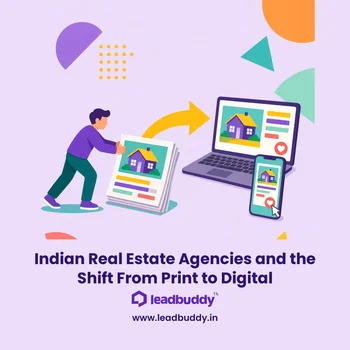
How Indian Real Estate Marketing Shifted From Print to Digital
Picture a Sunday morning in Kolkata a decade or two ago. Tea, the newspaper, and a full front-page jacket ad for a new project in Rajarhat. That ad was the launch. Phones rang at the site office all week.
Plenty of Indian families still read the Sunday paper. But the way buyers search and decide has moved largely onto phones. The top real estate marketing companies in India have had to rebuild how they work around that shift, and developers who grew up on print are working out what to keep and what to let go.
What did print do well?
Print gave instant credibility, because a full-page ad signaled a serious developer. It offered mass reach in a single day, a physical object families discussed at the table, and simple buying. Its weaknesses were just as real: no clear tracking, paying for readers who'd never buy, and an ad that vanished with the paper.
Let's be fair to print. It offered:
- Instant credibility. A full-page ad signaled a serious developer.
- Mass reach in a single day.
- A tangible object families discussed at the table.
- Simplicity. Book space, send artwork, done.
Its weaknesses were just as real. You couldn't easily tell which enquiries came from which ad, you paid for readers who'd never buy, and once the paper was recycled, the ad was gone.
What did digital change?
Digital brought targeting by city, interest and behaviour; measurement of clicks, enquiries, site visits and, with a connected CRM, bookings; flexibility to change a headline mid-week; an always-on presence through search; and rich content like video, virtual tours, floor plans and payment calculators that print simply couldn't carry.
Digital marketing brought:
- Targeting. Ads reach people by city, interest and behaviour, not everyone who reads one paper.
- Measurement. You can track clicks, enquiries, site visits and, with a connected CRM, bookings.
- Flexibility. Change a headline on Tuesday rather than waiting for next Sunday.
- Ongoing presence. Search ads catch buyers whenever they're looking.
- Rich content. Video, virtual tours, floor plans and payment calculators.
Is print dead?
No. For some projects and audiences, print still plays a role: launch announcements for big developers, older audiences in certain cities, or regional language papers in tier-2 markets. Say you're launching in Lucknow or Coimbatore. A well-placed local paper ad alongside digital can still help.
The difference is that print is now one part of a plan, not the whole plan. A good agency will ask what print is supposed to do and how you'll know whether it worked.
| Factor | Digital | |
|---|---|---|
| Reach | Mass reach in one day | Targeted by city, interest, behaviour |
| Measurement | Hard to track | Tracks clicks to bookings with CRM |
| Flexibility | Fixed until next edition | Change creative any day |
| Content | Static image and text | Video, tours, floor plans, calculators |
| Credibility | Strong signal of seriousness | Built through consistency and reviews |
Making print measurable
If you do run print, give it its own tracking:
- A unique phone number
- A QR code leading to a dedicated landing page
- A specific offer code or URL
- Sales teams asking "where did you hear about us?" and logging the answer
That way print gets judged on the same basis as digital.
How agencies changed
Agencies that were built for print had to add new skills: search, social, data, CRM integration, video and analytics. Some made the shift well. Others added a small digital team in the corner. When you meet agencies, ask how their teams are structured and who'd actually run your campaigns.
A performance marketing agency for real estate developers lives in data and optimization. A creative-led agency may be stronger on brand and ideas. The best combine both.
Channels that replaced print's role
- Search. A Google Ads expert for real estate lead generation captures buyers when they're actively looking.
- Social. Meta and YouTube give reach and awareness, the job print used to do.
- Portals. Property portals list projects where buyers compare.
- WhatsApp. Follow-up and sharing among families.
- Outdoor. Hoardings near the site and in feeder areas, still a strong local signal.
Landing pages took over print's job
A print ad had one chance to persuade. Today a landing page does that work, and it can be tested and improved every week. A conversion rate optimization agency for real estate landing pages will try different headlines, form lengths and floor plan layouts, and keep whatever brings more genuine enquiries. Print never let you do that. If you want a single team handling all of it, a full-service real estate marketing partner can run pages, ads and reporting together, so nothing falls between two vendors.
What hasn't changed?
Buyers still want trust, clarity and a good site visit. Digital makes reaching people easier, but the basics of selling a home are the same: a real product, honest information and a sales team that follows up quickly. Any agency, print or digital, still succeeds or fails on those fundamentals.
Buyers still want trust, clarity and a good site visit. Digital makes it easier to reach people, but the basics of selling a home remain the same: a real product, honest information and a sales team that follows up.
Budget shifts
Developers who moved from print to digital often find the budget goes further because there's less waste. But spending moves into new places: content production, landing pages, CRM tools. Compare total costs, not just media, when you look at the cost of hiring a real estate digital marketing company.
[Add LeadBuddy observation: how a client's print-to-digital budget split changed]
Questions to ask an agency
- What share of your work is digital today?
- When would you still recommend print?
- How do you track print alongside digital?
- Who on your team handles search and social?
- How do you report results?
Final word
The shift from print to digital wasn't just a change of medium. It changed how marketing gets measured and improved. The top real estate marketing companies in India use print where it still earns its place and rely on digital for reach, targeting and accountability.
At LeadBuddy, we're digital-first and track every channel, including print if you use it. Book a free strategy call to plan your media mix.
From our base in Mumbai, we've found this holds for MahaRERA-registered projects in Thane and Navi Mumbai just as much as for projects in other states.
Key takeaways
- Print gave instant credibility, because a full-page ad signaled a serious developer.
- Digital brought targeting by city, interest and behaviour; measurement of clicks, enquiries, site visits and, with a connected CRM, bookings; flexibility to change a headline mid-week; an always-on presence through search; and rich content like video, virtual tours, floor plans and payment calculators that print simply couldn't carry.
- No.
- If you do run print, give it its own tracking:
- Agencies that were built for print had to add new skills: search, social, data, CRM integration, video and analytics.
Frequently asked questions
Is newspaper advertising still useful for real estate?
Sometimes, for launches and brand credibility in certain markets. Make it measurable with unique numbers, QR codes and dedicated landing pages.
What replaced print in real estate marketing?
Search ads, social and video, property portals and landing pages took over most of print's reach and information roles.
How should I measure print ads?
Use a unique phone number, QR code or short URL per ad, and track those enquiries through to site visits in the CRM.